










- Accueil
- Automobile
Automotive Supply Chain Management
Connecting the automotive supply chain
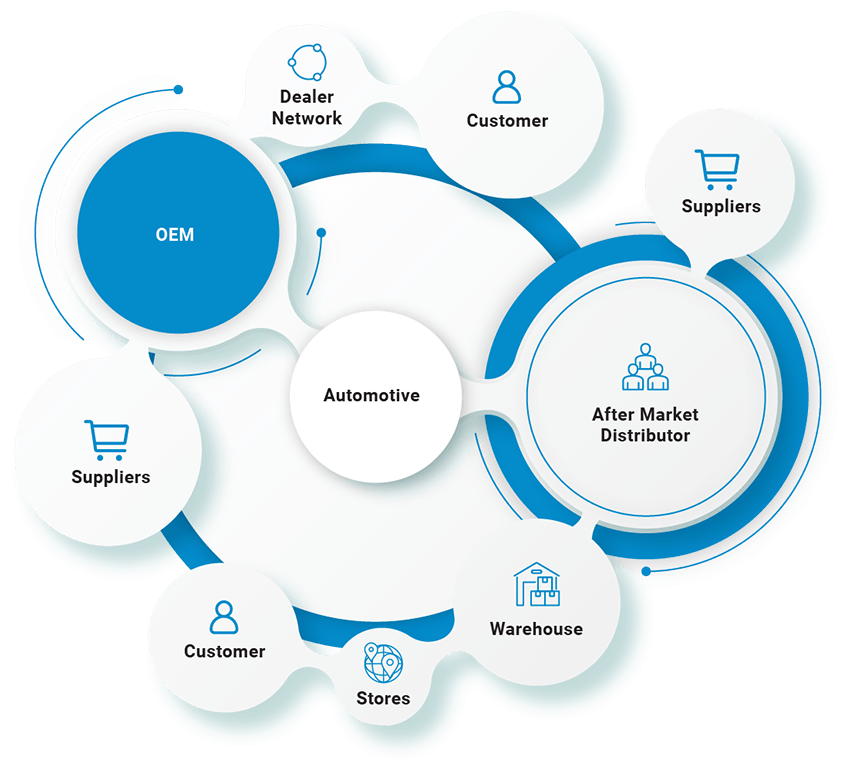
The automotive supply chain brings together OEMs, manufacturers, suppliers and aftermarket distributors in a highly structured, fast-paced trading environment. Precision, speed and reliability are critical, with just-in-time production, complex supplier networks and strict data standards shaping how businesses operate. To keep vehicles and parts moving efficiently, the industry relies on automated, standardised ways to exchange orders, invoices and supply chain data across multiple trading partners.
Automotive Supply Chain Challenges
Challenge 01
Small Margin For Error
Just-in-time (JIT) manufacturing reduces variability and costs, but leaves little margin for error. Sudden demand surges or supply disruptions can quickly delay shipments, creating profitability risks and customer dissatisfaction for OEMs handling time-sensitive orders.
Challenge 02
Supply Chain Complexity
Automotive supply chain managers work closely with thousands of manufacturers and suppliers on average to avoid costly and untimely supply chain delays which can lead to bigger consequences such as factory shutdowns. This can affect up to 30,000 critical components on an average OEM vehicle.
Challenge 03
Supply Network Disruption
Recent years have highlighted how vulnerable automotive supply chains can be to disruption. Events such as global component shortages and the Covid-19 pandemic significantly reduced production, reinforcing the need for more resilient and adaptable supply chain operations.
Challenge 04
Unique Document Set
OEM automotive supply chains use a very specific set of electronic documents to ensure that the just in time supply chain operates efficiently. Many documents such as the material release schedule (MRS) aren’t easily integrated into systems and sometimes are only used for the planning stage.
Challenge 05
Aftermarket Complexity
Thousands of vehicle brands and models create demand for a vast range of parts. Suppliers must deliver both original and aftermarket components to garages and retailers within tight timeframes, as limited on-hand stock increases reliance on fast, accurate order fulfilment across large supplier networks.
What Good Looks Like On The Ground
Production schedules run without constant intervention.
Suppliers receive clear demand signals and respond in line with agreed commitments.
Orders, forecasts, and delivery confirmations move consistently between partners, regardless of format, system, or location.
Teams are not manually chasing updates, reconciling discrepancies, or reacting to last-minute shortages. They are working from reliable information, resolving exceptions early, and keeping parts flowing through the network without disruption.
- Trading partners exchange information in structured, predictable ways.
- Exceptions are identified early, before they impact production or delivery.
- New suppliers and customers can be introduced without destabilising operations.
Supply Chain Connections




















Solutions For The Automotive Industry
Échange de données informatisé
Enable the exchange of invoices and other automotive documents in multiple EDI formats, including EDIFACT, ANSI X12 and XML, through a single connection that removes internal complexity. This approach supports both OEM and aftermarket standards, making it easier to trade electronically across the automotive supply chain.
Web EDI
Enable suppliers - even those who cannot support full EDI integration - to securely view, acknowledge, and respond to automotive supply chain documents through a simple, browser-based interface, improving data accuracy compared to email and spreadsheets.
How It Works
Helping Your Automotive Supply Chain Thrive
Increased Accuracy and Visibility
Consolidate partner data on a single platform for better transparency and service. OEMs and aftermarket distributors can reduce errors, track updates in real time, and respond faster.
Cost Reduction
Integrating automation is an immediate necessity, one that will speed up automotive supply chains and minimise errors. These benefits will reduce operational costs while increasing productivity and improve supply chain management.
Multi-standard Support
Support multiple EDI standards and document types, enabling any automotive document to be exchanged in the required format. This flexibility allows OEM and aftermarket suppliers to integrate some or all documents while maintaining compliance, accuracy and responsiveness across the automotive supply chain.
Onboarding and Engagement
Enable faster electronic trading by combining automation with supported onboarding and supplier engagement. This approach helps aftermarket distributors overcome slower supplier adoption by managing onboarding and reducing the day-to-day effort of supplier engagement.